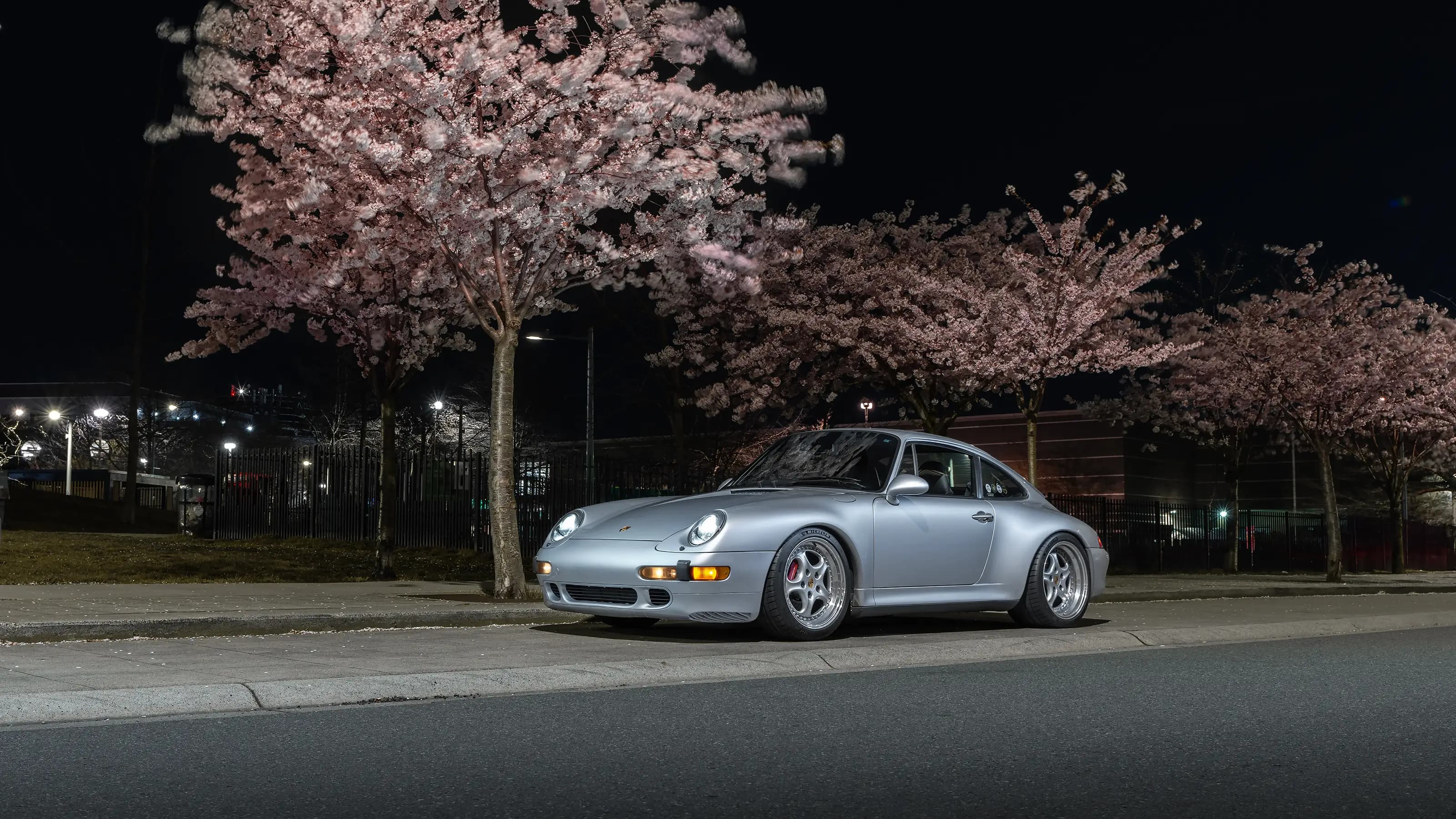
Ask ten car photographers for their favorite light and you'll get two answers: the last hour of sun, or hours after it's gone. Both produce the images people frame — but they're completely different shoots. If you're deciding what to book, here's how they actually compare.
What golden hour does for a car
Golden hour — roughly the last 60–90 minutes before sunset — wraps a car in soft, warm, directional light. Paint gets depth, chrome goes amber, and long shadows separate the car from the background.
Where it shines:
- Classic and vintage cars. Warm light flatters chrome, curves, and period-correct paint like nothing else.
- Bold colors. Reds, yellows, greens, and blues get richer as the light warms.
- Scenic backdrops. Ocean, mountains, skyline — Vancouver's landscape becomes part of the shot. A matte Lamborghini at Spanish Banks at sunset is exactly this recipe.
The catch: the perfect window is short. Maybe 40 minutes of truly great light, and it moves through phases fast — which is why arriving prepared and on time matters more for sunset sessions than any other type.
What night does for a car
Night shooting is a different craft. Instead of working with one giant light source, we build the image from many small ones — street lamps, parkade fluorescents, neon signs, city glow, and controlled lighting I bring.
Where it shines:
- Modern and modified cars. Widebody kits, aggressive stance, and aftermarket lighting look their most cinematic against dark backgrounds. See the yellow BRZ on ADRO aero — that entire set is night work.
- Reflective drama. Wet asphalt after Vancouver rain doubles every light in the frame. Genuinely, rain is a feature.
- Total control. No race against the sun. We can spend 20 minutes perfecting one composition, use light painting on the body lines, and dial reflections precisely.
- Privacy. Parkades and industrial areas are empty at night — no crowds, no waiting for pedestrians to clear frame.
The catch: night shoots are slower per image and depend more on location scouting — the light that exists is the light we compose with.
Side by side
| Golden hour | Night | |
|---|---|---|
| Mood | Warm, scenic, timeless | Cinematic, moody, urban |
| Best for | Classics, bold colors, landscapes | Modern, modified, dark colors |
| Shooting window | ~40–90 minutes, unforgiving | As long as we want |
| Weather dependency | High — needs a decent sky | Low — rain actually helps |
| Vancouver timing | Sunset ranges ~4:15pm (Dec) to ~9:20pm (June) | Any season, any night |
Why I usually recommend both
Here's the professional secret: the best sessions are golden hour into night. We start with warm light at a scenic spot, shoot through sunset and blue hour — the 20 underrated minutes when the sky goes deep blue and city lights come on — then move to a parkade or urban location for the night set. One session, two completely different galleries.
Vancouver is unusually good for this: you can shoot sunset at the water and be under downtown lights fifteen minutes later. It's the format behind most of the portfolio work on this site.
Frequently asked questions
What about shooting mid-day? Possible, but harsh overhead sun creates hard shadows and blown highlights on paint. If mid-day is the only option, overcast skies are the goal — Vancouver provides them generously.
Does rain cancel a night shoot? Light rain usually improves it — wet ground, reflections, atmosphere. Heavy sustained rain we reschedule, free with 48+ hours' notice.
Which is more expensive? Neither, inherently — pricing depends on scope, not the clock. The golden-hour-into-night combo is the best value per finished image.
Not sure which suits your car? Send me a photo of it and I'll tell you exactly what I'd shoot: arashyx@gmail.com.